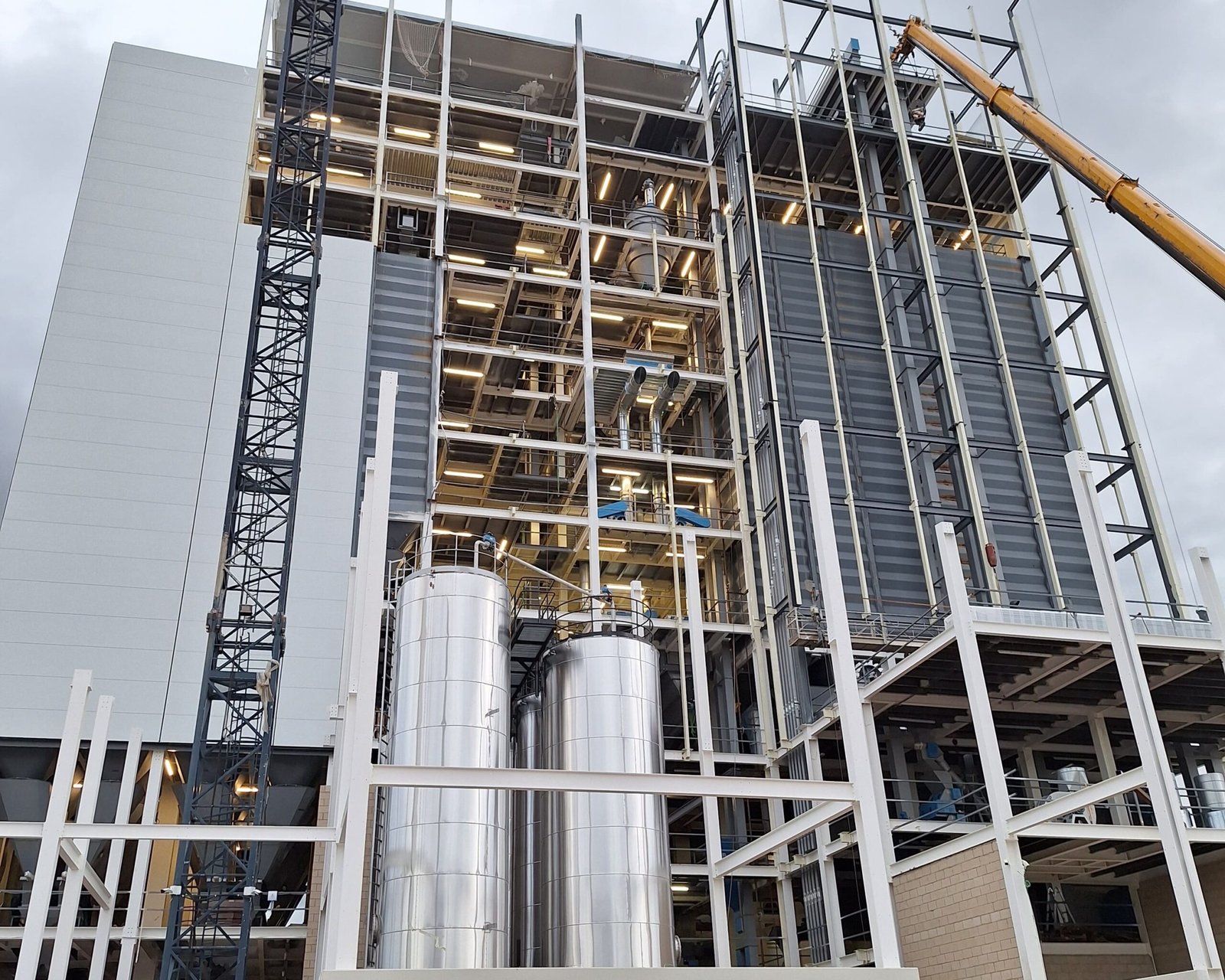
The design and construction of feed mills has evolved towards facilities capable of combining high production capacities with strict standards of safety, efficiency and flexibility. In this context, the project presented below exemplifies how a modern plant can be conceived from scratch to offer an immediate throughput of 40 t/h and, at the same time, be prepared to double its capacity without major restructuring.
| Type of project | Turnkey plant |
| Location | Spain |
| Installed capacity | 40 t/h |
| Planned expansion | Second line of + 40 t/h |
| Processes included | Receiving, dosing, milling, blending, premixing, granulation, conveying and loading |
| Regulations | ATEX Zone 22 |
| Number of lines | 2 complete and independent lines |
| Year of execution | 2021 |
The client, one of the main national producers, needed a new feed mill combining high capacity, operational reliability and growth potential. The initial target was set at 40 t/h real, but with the premise of designing from the beginning an infrastructure prepared to incorporate a second line that would multiply the capacity to 80 t/h.
Rosal undertook the project from the conceptual engineering phase through to commissioning, following a turnkey approach. The priority was not just to install equipment, but to create a consistent, safe plant capable of maintaining product quality with minimal variability.
The installation had to respond to several critical challenges:
- Complete integration of the process, from reception to dispatch.
- Accuracy in dosing and weighing on a large scale.
- Strict compliance with ATEX regulations.
- Stability of the production flow without bottlenecks.
- Scalability without future structural changes.
Global engineering: from design to assembly
The project was developed as a completely new plant, optimized by means of a vertical flow that takes advantage of gravity to reduce consumption and simplify internal transportation. This approach made it possible to coordinate design, machinery fabrication, integration of external equipment and on-site assembly under a single technical criterion.
The plant was structured so that each system was part of a continuous and robust production chain, capable of running three shifts per day with stability.
Receipt of raw materials
The reception area was designed to handle high volumes by means of a large hopper with vibrators, chains, and bucket elevators high-capacity. The elevators include rotation sensors, anti-jamming systems and web displacement detectors.
The area is complemented by:
- High power magnetic separators.
- Rotary pre-cleaning to remove foreign bodies.
- Distributed suction for ATEX safety.
Dosing and weighing: accuracy for formulation
The next stage consists of the dosing and weighing of each raw material. In a high-capacity plant, precision is a determining factor: any deviation affects not only the quality of the feed, but also its cost. For this reason, the plant incorporates an extraction system using pneumatic dosing closures and threads designed to control the flow even in difficult or poorly flowing products. The main weigh hoppers have a capacity of up to 4,000 kg, making it possible to work with macros and semifaros without production queues or delays.
Capacitive sensors, limit switches and timed valves enable fine and stable flow rate regulation. The system distinguishes between coarse and fine dosing, ensuring that the scale receives exactly the programmed quantity for each batch. This stage of the process is specially protected against dust, with rigid hoods, dust bellows and decompressions that facilitate clean discharge to downstream stages.
The installation also has a group of pneumatic beaters strategically located to avoid sticking in the hoppers and to favor the homogeneity of the fall flow. This combination of mechanics and pneumatics ensures that the raw materials reach the mill in optimal conditions.
Milling: power, control and safety
Milling is entrusted to two Hammer mills 200 kW, capable of supporting the full flow of the line. Each includes a grooved roller feed system designed to distribute the product evenly and prevent overloading. The mills feature high-powered permanent magnets, interchangeable screens and an automatic reversing system, which prolongs hammer life and reduces irregular wear.
Temperature sensors in bearings and grinding chamber allow real-time monitoring of the operation. Safety is again a key aspect: in case of overheating, obstruction or electrical anomaly, the system acts automatically to stop the equipment and prevent further damage. The suction system around the mill ensures a clean working environment and reduces the risk of explosions due to dust in suspension.
The result of this stage is a homogeneous flour, with a constant particle size and suitable for fast and efficient blending.
Mixture: the heart of the plant
The mixing stage is critical to the final quality of the feed. In this installation, the horizontal mixer MPR-8.000 is the heart of the process. With a nominal capacity of 8,000 liters and an effective load of 4,000 kg per batch, it can reach 40 tons per hour with coefficients of variation between 5 and 10 %, values that ensure a uniform distribution of each ingredient in the final product.
The mixer bowl is made of stainless steel AISI-316, resistant to abrasion and easy to clean. The rotor incorporates adjustable blades that optimize the mixing time according to the formula. The tilting closure with inflatable seal facilitates fast and complete emptying of the mixture, avoiding contamination between batches. This last point is especially relevant in the manufacture of feed for animals with different nutritional needs, as it allows changing the formula without dragging residues from the previous batch.
In addition to main blending, the plant includes a complete manual addition system using hoppers equipped with its own load cells and filters, allowing the incorporation of sensitive ingredients or very small quantities. The micro-dosing and mineral dosing network - with dedicated 10, 100 and 200 kg hoppers and 16-way distributors - provides exceptional accuracy and ensures that even critical ingredients are correctly integrated.
Pelleting
The installed granulation line combines conditioning, The double conditioner allows to work with long residence times, essential to improve pellet digestibility and cohesion. The double conditioner allows working with long residence times, essential to improve the digestibility and cohesion of the pellet. It is prepared to incorporate steam, water and molasses, although the installation of liquids is left for future expansion according to the customer's needs.
The pelletizing press, equipped with a 250 kW motor, works with 4 mm dies and tapered rollers, and is protected by a mechanical clutch that prevents damage in case of overload. The automatic lubrication system and ergonomic access facilitate maintenance tasks. Once compacted, the pellet enters a large-capacity countercurrent cooler, where temperature and humidity are reduced in a controlled manner, essential conditions to ensure its stability during storage.
As a final stage of the pelletizing process, the plant incorporates a suction system with stainless steel cyclones and specific paddle conveyors for pellet handling without breakage or segregation.
Conveying, suction and pneumatics
One of the differential elements of this project is the integration of inland transportation: a network of chain conveyors, The double-deck versions were used in sections where it was necessary to reduce structural space or improve conveying efficiency. Double-deck versions were used in sections where it was necessary to reduce structural space or improve conveying efficiency.
Centralized suction and more than twenty filters distributed at critical points ensure that the plant operates with minimum dust levels, contributing to both ATEX safety and operator comfort. The pneumatic network, powered by high-performance compressors, ensures continuous operation of seals, valves, cylinders and auxiliary systems.
Bulk cargo
The bulk loading area was designed to minimize truck waiting times and improve customer logistics. Collecting hoppers under cells and dedicated conveyors allow the final product to be sent directly to the loading tunnels. Dust sleeves and pneumatic opening and closing systems ensure a clean and fast process.
The design also contemplates the future incorporation of bagging systems, which can be added without modifying the existing flows.
Preparation for a second 40 t/h line
One of the key aspects of this plant is its scalability. Although the currently operating line is 40 t/h, the entire facility has been built with the foresight to add a second mixer, a new mill and another granulation line. The dimensions of the structures, the pipe diameters and the layout of the conveyors allow this expansion to be executed with an incremental investment and without stopping current production.
This long-term vision is particularly relevant in the animal feed industry, where demands can change rapidly and the ability to grow quickly is a strategic factor for competitiveness.
Conclusion: a modern, efficient and future-proof factory
The plant developed by Rosal in Spain is an example of large-scale applied engineering. The customer now has a plant at its disposal:
-
efficient in terms of energy and process;
-
safe against explosive atmospheres thanks to a consistent ATEX design;
-
precise and stable at all stages, from dosing to granulation;
-
prepared to double its capacity without redoing the structure;
-
and built with robust equipment, designed for years of continuous operation.
This project demonstrates Rosal's ability to tackle complete facilities from scratch, integrating proprietary technology with specialized equipment and tailoring each solution to the customer's specific needs. The plant not only responds to current market requirements, but is also prepared to grow and evolve in line with the challenges of feed production in the coming years.