
In the design of an animal feed factory, the cooler doesn't usually take center stage in technical decisions. The pellet mill, conditioner, and expander capture attention due to their direct impact on performance and quality, while the cooler tends to be specified by rated capacity and integrated as another catalog item.
This hierarchy of priorities, however, does not correspond to the actual impact of cooling on the final product quality. A significant portion of the problems that arise downstream—fines in screening, loss of durability, microbiological development in the silo—originate from a deficient sizing of this stage. The cost of an undersized cooler is not reflected in the initial investment; it manifests months later, in the form of difficult-to-explain losses, structural fragility of the pellets during transport, and claims from the final customer.
It is therefore advisable to review in some detail the parameters governing the process and why the choice of size does not allow for simplification.
The double error: undersizing and oversizing
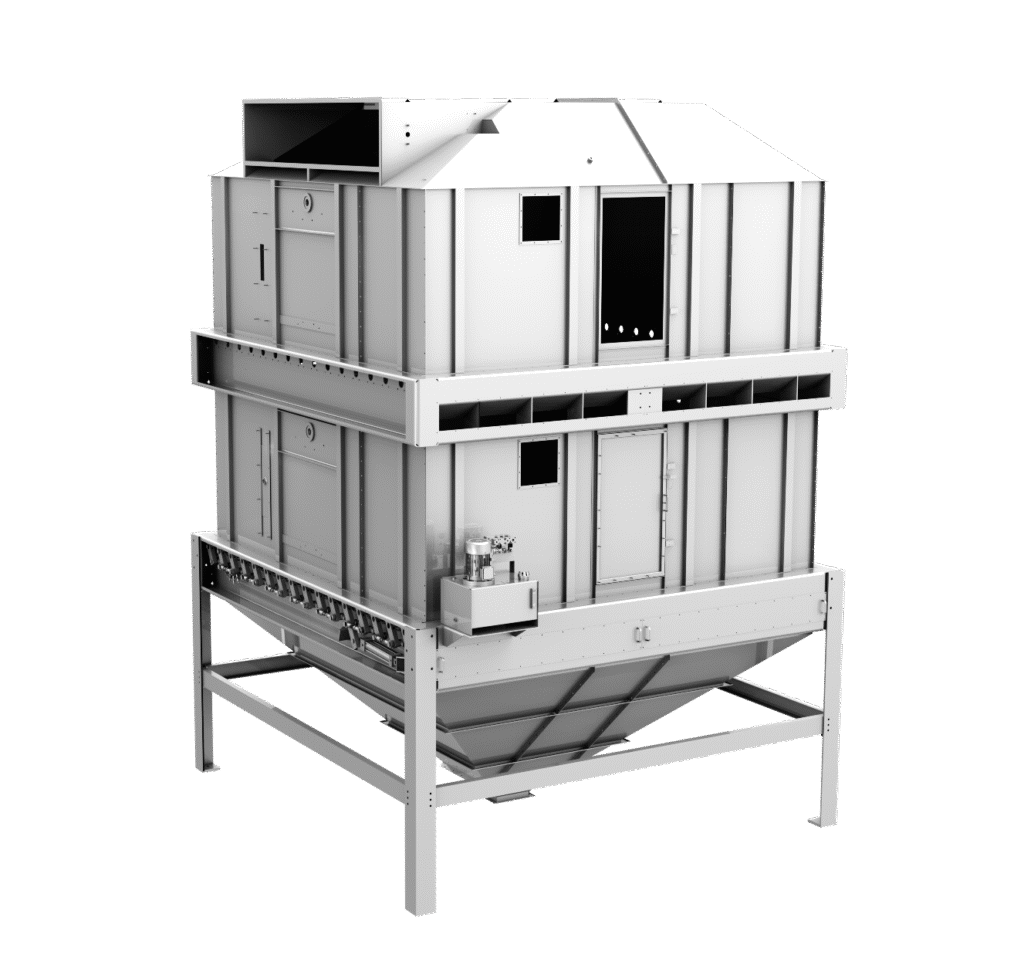
The most common intuition during the purchasing phase assumes that an oversized cooler offers greater security than an undersized one. The logic is reasonable for other plant equipment, but it does not apply to cooling.
Undersizing produces pellets with temperatures and moisture levels above the permissible range. The product arrives hot in the silo, condenses against the metal walls, and creates conditions favorable for fungal development during storage. It is a well-documented failure and, precisely because of its visibility, rarely deliberate.
Oversizing is more subtle and, therefore, more common. A cooler with a capacity significantly larger than that required by the upstream pelletizer exposes the product to ambient air for an excessive amount of time, with a flow rate calibrated for higher production. The result is systematic over-drying: final moisture content below the optimal range and, with it, a direct loss of sold weight. In a plant producing 100,000 tons annually, a single percentage point of moisture lost due to over-drying represents a considerable economic impact that is rarely attributed to its real cause.
The parameters that truly govern the process
Technical literature on drying and cooling of pellets, particularly the work of Maier and Bakker-Arkema Regarding countercurrent coolers published in 1992 and still referenced in the industry, clearly identify the dominant design parameters. They do not align with what intuition places in the foreground.
The four factors that determine the outcome, ordered by their actual weight on the process, are as follows:
- Bed depth. The thickness of the pellet column within the cooler determines the mass of product exposed to air at any given moment and, along with the discharge rate, the time each granule remains in the equipment. Typical depths in industrial coolers range from 750 to 1,500 millimeters, and their selection is not based on geometric criteria but directly on the expected drying and cooling capacity.
- Residency time. Closely linked to the previous point. When the pellet enters the cooler, the water is not distributed uniformly within the granule: the core retains the moisture incorporated during conditioning, while the surface has already given up some of its content during the journey from the press. To achieve a stable and homogeneous final moisture content, the internal water must migrate to the surface and from there be released into the air. This internal diffusion process is slow, taking minutes, and any design that does not account for these minutes will compromise the final result.
- Product inlet temperature. A pellet that enters the cooler warmer maintains a greater thermal differential with the air and, consequently, a greater capacity for heat transfer and moisture removal. Proper thermal conditioning in the prior phase not only improves pellet quality but also optimizes the cooler's performance.
- Ambient relative humidity. Intuition is given greater importance than it actually has. Maier and Bakker-Arkema's analysis concluded that the humidity of the incoming air is a less significant factor in the design of the counterflow cooler, a conclusion that later literature has maintained. The explanation lies in the fact that as the air passes through the bed, it heats up rapidly and its moisture-carrying capacity increases, so its initial state has less influence than anticipated.
This does not render climate irrelevant—as will be seen later—but it does shift the focus from geography to product and process characteristics.
The dry crust: the invisible problem of aggressive cooling
There is a physical phenomenon whose understanding is essential because it explains a substantial part of quality problems that are usually attributed to other causes. In the literature on drying grains and oilseeds, where it is perfectly documented, it is called case hardening It's a dry crust. It forms when the rate of evaporation on the product's surface exceeds the rate of water migration from the interior.
In a cooler, the phenomenon occurs when the air is excessively cold or the flow rate is too high in relation to the residence time. The surface of the pellet loses moisture rapidly and hardens, forming a crust, while the core retains a significant fraction of the original water. Upon exiting the counterflow cooler, the product appears to be in good condition: temperature within the expected range, surface moisture at acceptable values. The problem manifests itself later.
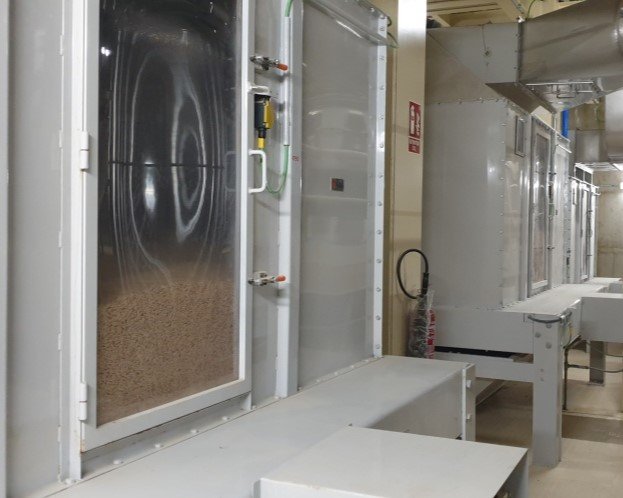
Once in the silo, the pellet tends towards equilibrium. Moisture trapped in the center migrates outward by natural diffusion, passes through the hardened crust, and destabilizes the internal structure of the pellet. The product becomes brittle during storage and handling, generating abnormal amounts of fines in any subsequent transport or bagging operation. The plant identifies the problem during screening, through durability claims, and from end-customer complaints, but the origin of the issue occurred long ago in the process.
For this reason, when sizing a counterflow cooler, the pertinent question is not solely how much heat needs to be removed, but at what rate it can be done without inducing an imbalance between the surface and the core. The answer depends on the product, the pellet size, and the formulation.
Airflow is not an independent variable
From the above, a conclusion arises that in practice encounters resistance: increasing the airflow does not improve cooling beyond a certain threshold, and from that point on, it deteriorates it. The optimal airflow is a function of bed depth, residence time, and product characteristics, and cannot be treated as an isolated variable.
An insufficient flow rate delivers hot, wet pellets, with the storage problems already described. An excessive flow rate rapidly cools the surface but prevents internal water migration, reproducing the dry crust effect.
Fine-tuning the flow rate also constitutes the main operational tool in a plant when environmental conditions vary throughout the year, but that regulation margin only exists if the base sizing is correct. No gate adjustment can compensate for an undersized cooler.
When standard dimensioning is insufficient
There are scenarios in which a cooler correctly sized for average conditions does not achieve the required result. The most common ones are:
- Plants in tropical climates or subjected to prolonged periods of high humidity, where the ambient temperature imposes too high a soil temperature on the final pellet temperature.
- Formulas with high liquid content —molasses, fats, fish oils typical in aquaculture— which contribute more moisture and thermal energy to the granule than a conventional cooler can manage within the intended residence time.
- Products especially sensitive to thermal stress, in which rapid cooling compromises the nutritional or structural integrity of the granule.
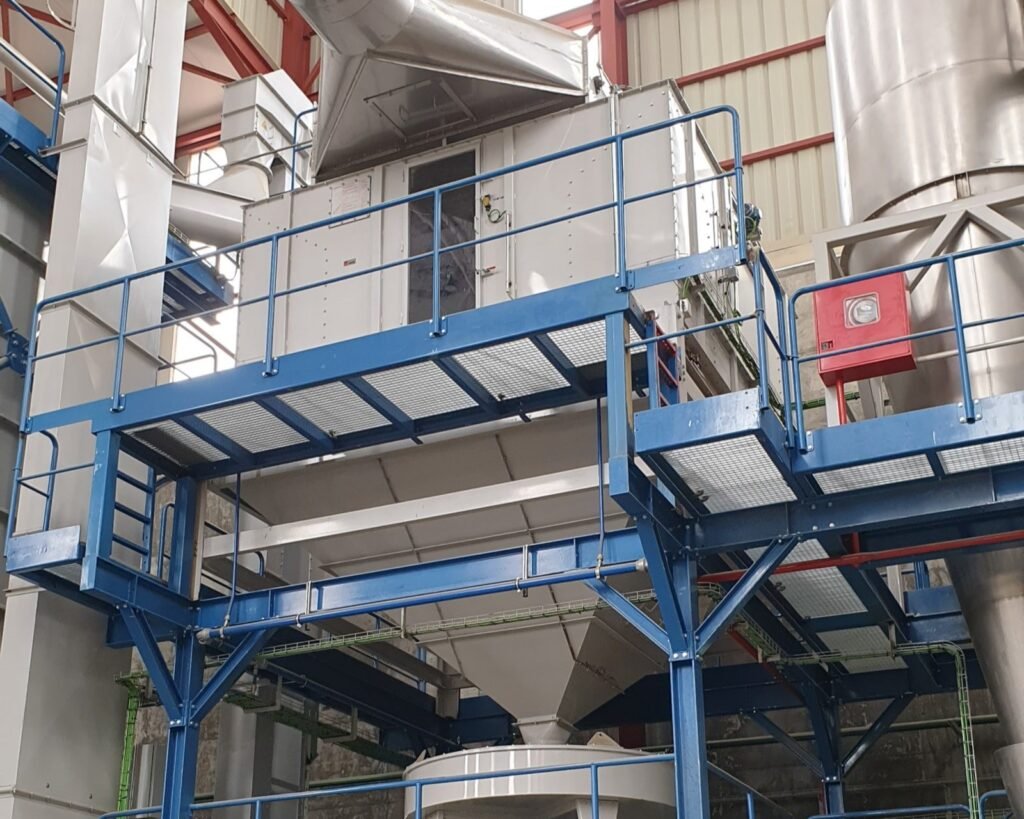
In these cases, pre-cooled and dehumidified air injection systems are used, capable of reducing the pellet temperature below ambient and maintaining pellet quality under conditions where a standard cooler cannot operate satisfactorily. This type of system and its applications are developed in greater detail in our Complete technical guide to feed pelleting.
Conclusion
Cooling is the phase where the work carried out in all previous stages of the process is consolidated or lost. Correct sizing is not achieved by selecting the largest capacity equipment available, but by understanding which parameters truly determine the outcome: bed depth, residence time, product inlet temperature, and a correspondingly adjusted airflow. Ambient humidity weighs less than intuition suggests; the dry crust, considerably more than most plants recognize.
Each project presents a specific geometry, formulation, and climatic environment. Therefore, the sizing of a chiller does not allow for generic tables: it requires case-by-case analysis. In new installation projects or when facing recurring problems with fine dust or humidity in existing plants, Rosal-Mabrik brings over six decades of experience in the sizing and supply of these equipment for clients on five continents.
Frequently Asked Questions
A counterflow cooler with a capacity significantly higher than required tends to over-dry the product, which translates into a direct loss of sold weight and, in many cases, into brittle pellets due to dry crusting during subsequent silo balancing.
The phenomenon is called dry crust or case hardening. This occurs when the pellet surface dries faster than internal water migration. The core retains moisture, which later migrates outwards in the silo, destabilizing the granule structure and generating fines and breakage during handling.
The dominant parameters are bed depth, residence time, and pellet inlet temperature. The airflow rate is a function of the previous ones, not an independent variable. Ambient relative humidity, contrary to what is usually assumed, has less weight in the design.
Bibliography
Brooker, D.B., Bakker-Arkema, F.W. and Hall, C.W. (1992). Drying and Storage of Grains and Oilseeds. Van Nostrand Reinhold, New York.
Maier, D.E. and Bakker-Arkema, F.W. (1992). «The counterflow cooling of feed pellets.». Journal of Agricultural Engineering Research, 53, 305-319. https://doi.org/10.1016/0021-8634(92)80089-B