
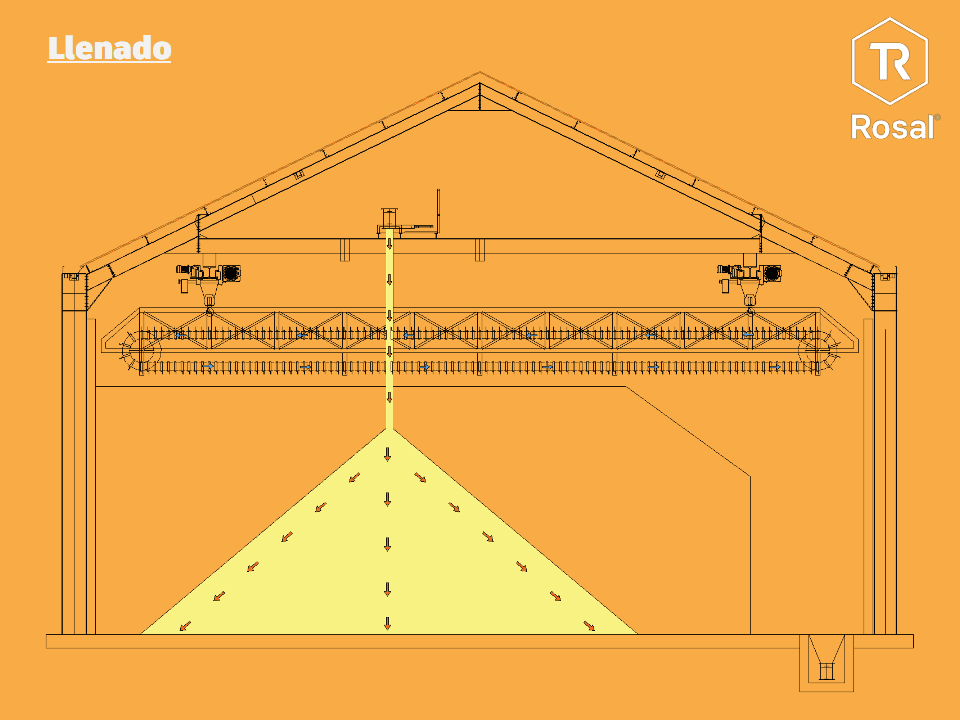
In a flat-bottomed warehouse, the product entering through the roof forms a cone beneath the discharge point. That cone leaves a good portion of the building's volume unused. Furthermore, when it is time to empty it, the work is usually done with a wheel loader: it is slow, generates dust, and forces operators to work next to material slopes that can collapse.
The chain extractor leveler of Rosal Solve both problems with a single piece of equipment. During filling, it distributes the product across the entire surface of the warehouse, and during emptying, it actively extracts it toward the discharge chute. It is a solution designed for feed mills, grain elevators, and flour and byproduct warehouses that need to make the most of every cubic meter.
What is a chain breaker and riveter tool
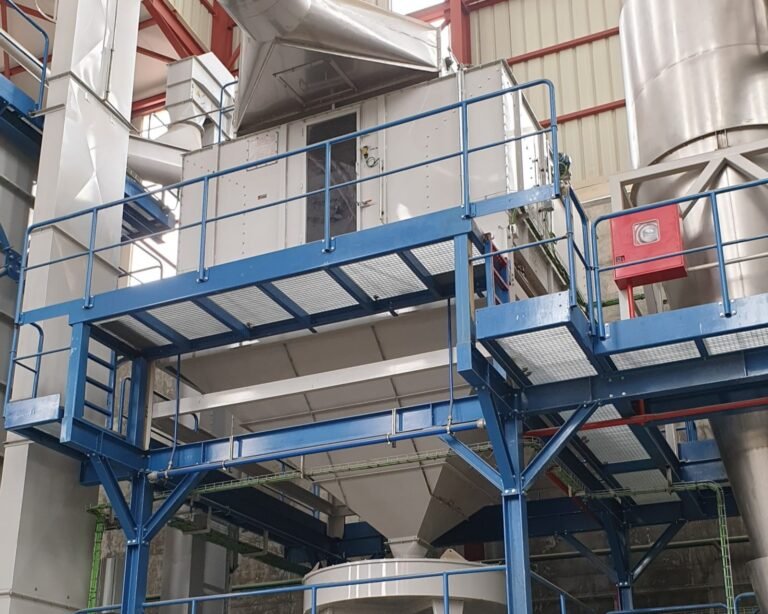
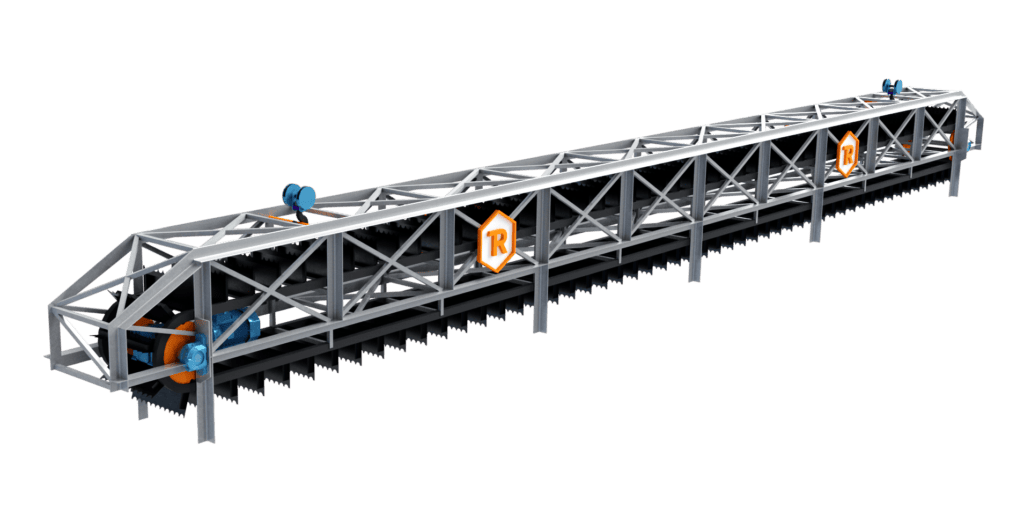
It is a bridge suspended from the ship's structure that runs along the warehouse at a height. Its working element is a drag chain conveyor with flights that circulates between a drive head and a return element. Two hoists allow the bridge to be raised and lowered in a controlled manner, adapting its position to the height of the product at all times.
Its main advantage over other solutions is its dual function: the same equipment levels during filling and extracts during emptying, without the need for mobile machinery inside the warehouse.
Advantages for a storage facility
- Maximum useful volume. By removing the pouring cone, the product covers the entire surface of the warehouse and the actual storage capacity increases.
- More security. Workers and machinery no longer work near unstable slopes, so the risk of landslides falling on people or equipment is eliminated.
- Semi-automatic operation. The operator supervises and the equipment executes the leveling and extraction cycles.
- Sensors depending on your installation. There is a wide range of sensors available to monitor bridge position and equipment operation.
- Product versatility. It works with soy, corn, and rice flour, as well as various by-products.
- High working speed, with capacities of up to 200 t/h.
How it works: the complete warehouse cycle
1. Top-discharge filling
The product enters the warehouse from the deck through the discharge point. As it accumulates, it forms a storage cone beneath the discharge. Without leveling, the warehouse capacity would be limited by the height and slope of that cone.
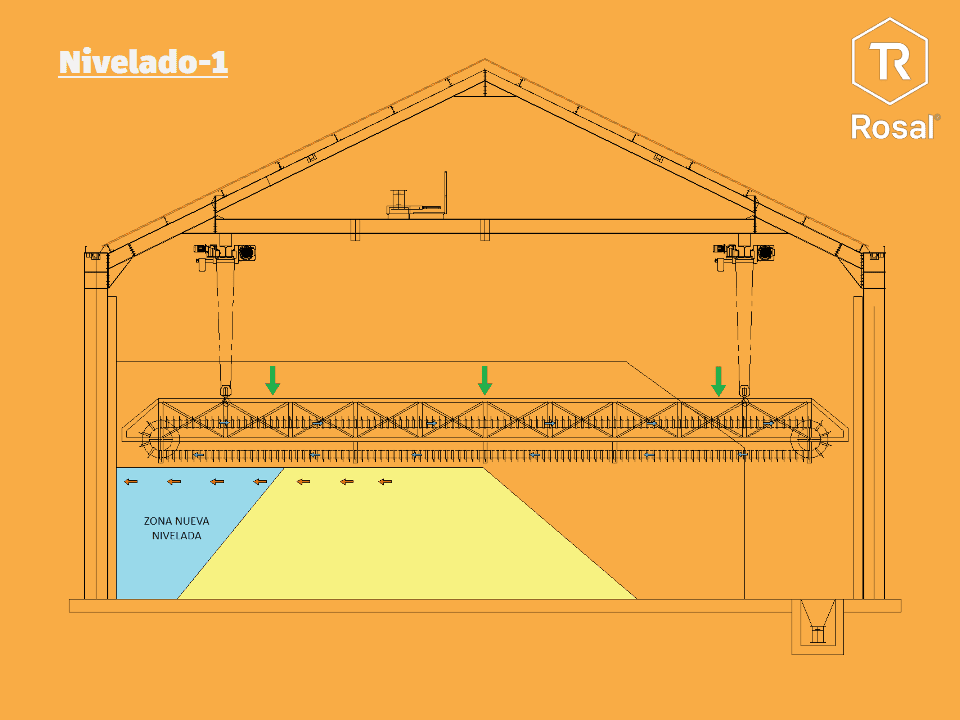
Staged leveling
When the cone reaches the height of the bridge, the leveler starts working. The bridge descends in a controlled manner using the hoists, and the paddle chain drags the product from the central area toward the sides of the warehouse.
The process is repeated in successive passes. With each one, the material is distributed homogeneously and areas of the warehouse that were previously empty are gradually occupied, until the entire available surface and volume are utilized.
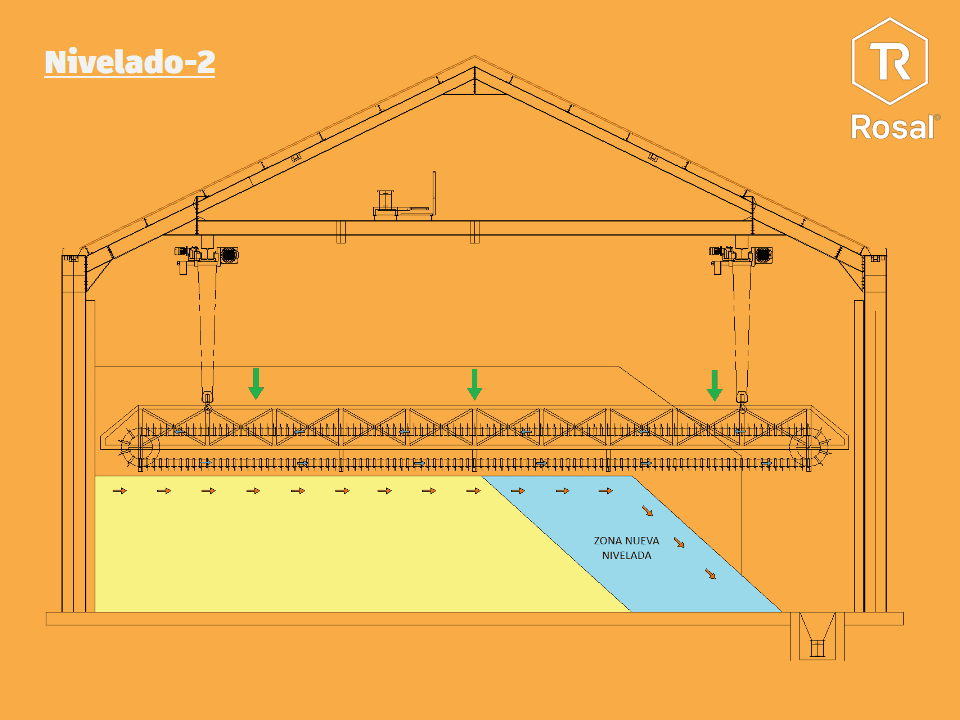
3. Emptying and active extraction
When the time for the expedition arrives, the team reverses its role and acts as extractor. The bridge descends progressively while the paddle chain sweeps the product toward the hopper and the lateral discharge chute. This achieves a continuous and rapid output flow that leaves the warehouse floor practically clean.
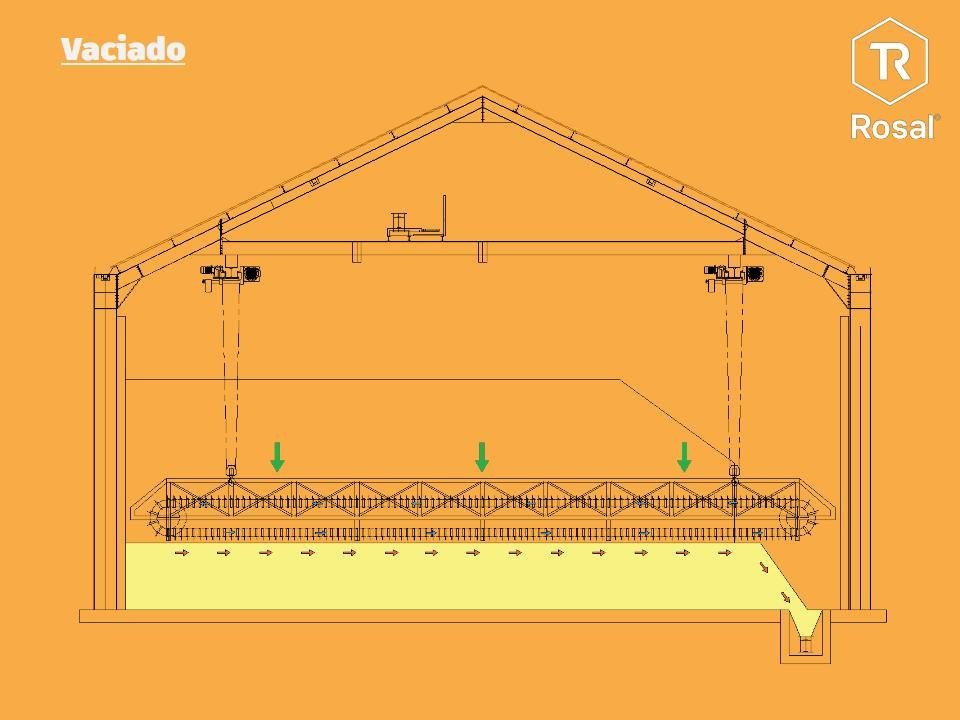
Why flours need active extraction
Clean grain flows with relative ease. The flours and by-products, instead, they tend to form very steep slopes, to cake, and not to slide on their own toward the discharge points. In a flat-bottom warehouse, this means that gravity discharge is not enough and a significant part of the product has to be moved mechanically.
The chain extractor leveller actively feeds the product to the discharge chute, without depending on its flowability. This reduces emptying time, avoids the work of wheel loaders inside the building, and maintains a stable dispatch flow rate.
Products you can handle
The team is prepared to work with various bulk products, including:
- Soy flour and other protein flours
- Corn
- Rice
- Agro-industrial byproducts
Each facility is studied according to the main product being stored, in order to adjust the equipment configuration.
Construction and components
The leveler is constructed as a steel lattice structure that serves as support for the mechanical elements:
- Drag chain conveyor with flights: the element that pushes the product, both in leveling and extraction.
- Drive head driven by a gearmotor, it transmits movement to the chain.
- Forwarding element: with chain tensioning system.
- Motorized hoists: they suspend the bridge and control its height throughout the entire cycle.
- Sensors: configurable according to the control and security needs of each plant.
Technical specifications
| Feature | Value |
|---|---|
| Capacity | Up to 200 t/h |
| Operation | Semiautomatic |
| Work item | Drag chain conveyor with flights |
| Sensors | Wide range available |
| Dimensions | Custom-made for the ship |
| Products | Flours, soy, corn, rice and by-products |
Frequently Asked Questions
Yes. The equipment is custom-designed, so the dimensions and structure of the building are studied in order to adapt the dock leveler to the current installation.
Emptying is faster and continuous, the presence of machinery and personnel inside the warehouse is avoided, and the risk of slope collapses disappears. In addition, the same equipment levels the product during filling.
Up to 200 tons per hour, depending on the configuration and the product.
Yes. It is prepared for soybean meal, rice, corn, and various by-products.
It is semi-automatic: the operator supervises and the equipment executes the leveling and emptying cycles, supported by sensors.